

Table of Contents
- Why Neck Gape Ruins Your Swim (And How to Spot It)
- How Should a Wetsuit Fit Around the Neck?
- Wetsuit Size Guide: Why Your Measurements Matter More Than Height
- Step-by-Step: Getting the Suit Fully Into Position
- Safe Fixes for an Existing Neck Gape
- Wetsuit Neck Chafing Prevention: Comfort Without Compromise
- Wetsuit Water Flushing: Testing Your Fit in Motion
- Conclusion: A Snug Neck Starts Before You Zip Up
- Frequently Asked Questions
Last Updated: October 5, 2026
Why Neck Gape Ruins Your Swim (And How to Spot It)
Neck gape is the gap between your wetsuit collar and your skin, and it quietly ruins cold-water swims. Spot it with one test: zip up, turn your head side to side, then press two fingers under the collar.
At Raceskin, we build wetsuits for open-water swimmers and triathletes, and we see the same problem every season. Swimmers blame the suit. Most of the time, the collar is fine. The fit is wrong.
Water Flushing: The Real Cost of a Loose Collar
Water flushing is the movement of cold water in and out of your suit through any loose opening. In a wetsuit, a thin layer of trapped water warms against your skin and holds heat in. When the neck seal leaks, that layer never forms.
Here is what a gape actually does to you:
- Cold water flushes in on every breath and stroke
- Your core temperature drops faster than you expect
- The collar rubs as it shifts, which causes chafing
- You tense your shoulders, and your stroke shortens
The fix is rarely a new suit. It is nearly always a fitting problem, and fitting problems have solutions.
How Should a Wetsuit Fit Around the Neck?
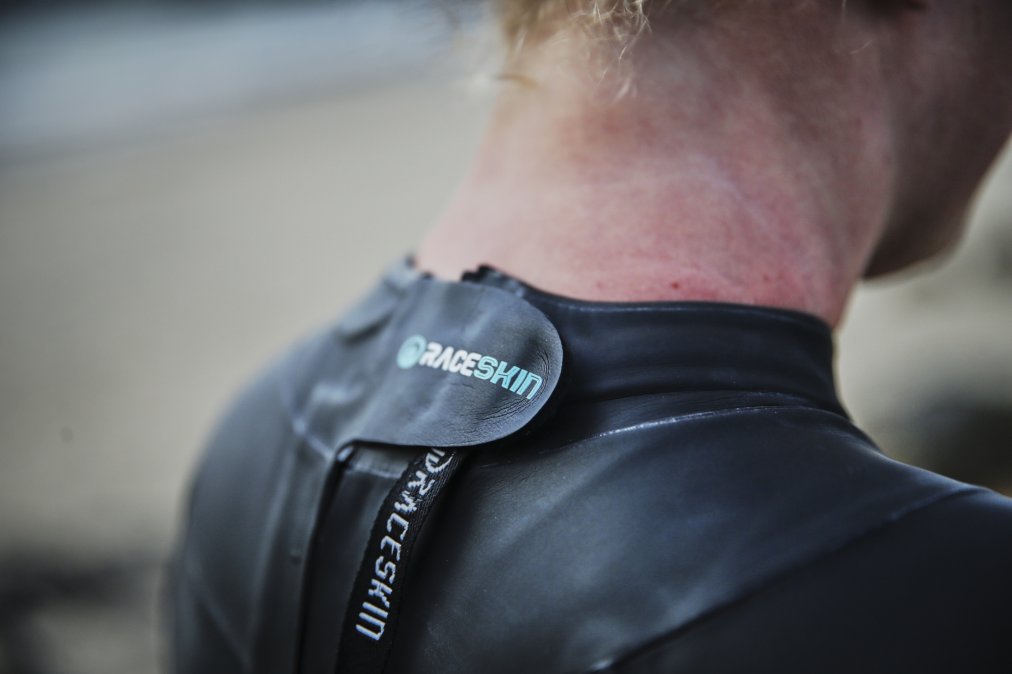
A wetsuit neck should feel snug but never tight: the collar sits flat against your skin all the way around, with no visible gap or fold, while you can still breathe and swallow without strain.
Think gentle compression, not pressure. If two fingers slide under the collar without effort, it is too loose; if you feel your pulse in your throat, it is too tight.
A good neck seal does three things:
- Sits flat, with no bunching or rolling
- Touches your skin evenly, front and back
- Moves with you when you turn your head, without opening
Wetsuit Size Guide: Why Your Measurements Matter More Than Height
A wetsuit size guide is a table of body measurements, not a height chart. Your chest, waist, hips, torso length, and neck circumference decide whether the neck seal closes properly.
Buying by height is the most common mistake we see.
Measure these before you order:
- Chest at its fullest point
- Waist at your natural waistline
- Hips at the widest point
- Torso length, from shoulder to crotch
- Neck circumference at the base
Take the measurements over light clothing, keep the tape level, and compare them against the size chart, not your usual clothing size.
When It's a Sizing Problem vs a Body-Shape Mismatch
A sizing problem means the suit is too big or too small.
Sizing problems are solved by swapping sizes; shape mismatches by changing suit cut or brand.
Here is how to tell them apart:
Symptom |
Likely Cause |
What to Do |
|---|---|---|
Gap all the way around the collar, evenly |
Suit too large |
Size down |
Tight at the neck, loose at the hips |
Body-shape mismatch |
Try a different cut |
Gaps under the arms and at the neck |
Torso too short for the suit |
Look for a longer torso cut |
Collar sits fine, lower back balloons |
Suit too large in the body |
Size down or change cut |
Shoulders tight, neck fine |
Broad shoulder span |
Try a suit cut for wider shoulders |
Collar gapes only when you raise your arms |
Torso length or shoulder cut |
Change cut, not size |
A useful diagnostic is the pinch test. Pinch the neoprene at the side of your ribs.
Women's wetsuits are cut differently from men's, with different panel shapes through the chest, waist, and hips.

If you have measured correctly and the same gap appears in two different sizes from the same brand, stop swapping sizes. The cut is wrong for your build, and a different neck-entry style, such as back-zip versus front-zip, will change how the collar sits more than any size change will.
Step-by-Step: Getting the Suit Fully Into Position
Most neck gape is caused by a suit that is not pulled up properly. If the fabric sits low in the body, it pulls the collar away from your neck.
- Step into the suit and work it up over your legs and hips.
- Pull the crotch and seat fully up. The suit should sit high, almost uncomfortably so, before you touch the top half.
- Work the fabric up your torso in small sections, not one big pull.
- Push your arms into the sleeves and settle the shoulders.
- Pull the collar up and over your head, then let it settle.
- Close the zip with the collar sitting flat against your skin.
- Reach inside the neck opening and smooth the seal all the way around.
The last step is the one everyone skips. Run your fingers around the inside of the collar and press the neoprene flat against your skin. Any roll or fold will leak.
Safe Fixes for an Existing Neck Gape
You can fix a small neck gape without altering the suit. Adjust position and fit first, then look at the suit itself.
Try these in order:
- Reposition the suit. Pull the body of the suit higher and smooth the collar flat. This fixes most gaps.
- Check the zip is fully closed and the collar is not caught under the zip flap.
- Add a neoprene neck seal or collar designed for open-water swimming. These sit over the existing collar and close small gaps.
- Check your base layer. A smooth, thin swim top under the suit helps the collar grip and reduces rubbing.
- Try a different size if the gap is even all the way around.
Never glue, tape, or cut the collar, those changes are permanent and usually make the leak worse.
If the gap only appears on one side, that is a shape mismatch, not a size problem. A different suit cut will serve you better than any adjustment.
Wetsuit Neck Chafing Prevention: Comfort Without Compromise
Wetsuit neck chafing prevention comes down to two things: a flat seal and less movement at the collar. Chafing happens when the collar rubs against damp skin for a long time, so a suit that shifts with every stroke rubs you raw.
These habits make a real difference:
- Smooth the collar flat before every swim, with no folds
- Use a thin layer of anti-chafe balm on your neck before you zip up
- Rinse the suit in fresh water after every swim to remove salt and chlorine
- Let the suit dry fully, inside and out, before you store it
- Keep your neck relaxed and avoid shrugging your shoulders in the water
A collar that fits well barely moves. That is why fit and comfort are the same problem, not two separate ones.
Wetsuit Water Flushing: Testing Your Fit in Motion
Test your fit in motion before you trust it in a race. A static check in the car park tells you very little, because your neck opening changes shape with every arm movement.
Run this simple check:
- Zip up and smooth the collar flat.
- Raise both arms overhead and turn your head left and right.
- Press two fingers under the collar. They should not slide in easily.
- Do 20 arm circles and check the seal again.
- If you can, wade into the water and duck your head under once. Feel for a rush of cold water at the neck.
If water pours in on the duck dive, the collar is too loose for open water, your signal to size down or change cut.
Test the Seal the Way Your Sport Moves
A collar that passes a standing check can still fail the moment you move the way your activity demands. The test has to match the sport.
- Open-water swimming and triathlon: the catch phase lifts the shoulder and pulls the collar away from the neck. Test with 20 full arm circles and a simulated sighting lift, where you raise your head and one arm together. If the collar lifts during the sighting lift, it will leak in a race.
- Surfing: duck dives push water against the collar from above. Test by ducking under a wave or, in flat water, by pushing the collar down with your hand while turning your head. A surf collar is built for repeated duck dives and sits higher and tighter than a swim collar.
- Scuba diving: pressure at depth compresses the neoprene and changes how the seal sits. Test in shallow water first, then check the seal again at depth on your first dive of the season. A scuba neck seal is built to hold against pressure, not against the repeated head rotation of front crawl.
A suit designed for one sport will not seal well in another. A triathlon collar is deliberately looser than a surf collar for range of motion and fast transitions. A surf collar stays put through duck dives, so it can feel restrictive to a swimmer who turns their head to breathe.
Fit Changes Over Time
Fit also changes over time. Neoprene loses shape retention with heavy use, so a suit that fitted perfectly two seasons ago may now sit looser at the neck.
Check your seal at the start of every season, not just when the suit is new.
Damage matters too. A nick or split in the neoprene at the collar, or a zip that no longer closes fully, will leak regardless of fit.
Conclusion: A Snug Neck Starts Before You Zip Up
Cold water at the neck is one of the fastest ways to ruin a long swim, and it almost always comes down to fit rather than the suit itself.
At Raceskin, we build wetsuits around exactly this problem. Our RS 01 men's and women's wetsuits use the latest neoprene fabrics for freedom of movement and a close, supportive fit.

Get race ready with Raceskin and swim your next event with a collar that stays sealed from the first stroke to the last.
Frequently Asked Questions
How should a wetsuit fit around the neck?
The neck opening should sit flat against your skin with gentle, even contact, not a tight squeeze. You should be able to slip one finger under the seal without forcing it. When you look down, the collar should stay in place rather than gaping away from your neck. Raceskin's RS 01 and RS O1 wetsuits are cut to deliver this snug, flat seal without restricting breathing or shoulder rotation.
Can a wetsuit neck gape be fixed without replacing the suit?
Often, yes. Before buying a new suit, check whether the neoprene is sitting too low on your torso. Pull the suit up at the crotch and waist so the collar rises into position. If the gape persists after repositioning, it is usually a sizing or cut mismatch. Safe, reversible adjustments like repositioning and correct zipping solve most gapes. Avoid trimming or gluing neoprene, as this damages the seal and voids the suit.
Why does water flush through the neck of my wetsuit?
Water flushing happens when the neck seal is not flat against your skin, letting cold water enter and circulate through the suit. This strips away the warm layer your body has heated and quickly reduces thermal insulation. A gape at the neck, lower back, or armpits makes flushing worse. Getting the suit fully pulled up and choosing the right size for your shoulder span and neck circumference are the most effective ways to stop it.
Is it better to size up or down in a wetsuit?
Neither, ideally. A wetsuit should fit snugly without restricting movement or breathing. Sizing up creates gaps at the neck, lower back, and armpits that cause water flushing. Sizing down causes bunching, chafing, and restricted shoulder rotation. Use the brand's size chart and measure your chest, waist, hip, and height. If you are between sizes, prioritise torso length and shoulder span over a single measurement.