

Table of Contents
- What Is a 'Second Skin' Fit?
- Triathlon Suit Sizing Guide: How to Measure Yourself
- How Tight Should a Triathlon Race Suit Fit?
- Triathlon Suit Chafing Prevention: Seams, Chamois and Friction Points
- Triathlon Race Suit Aerodynamics: Why Fit Matters
- One-Piece vs. Two-Piece: Fit Differences That Matter
- Fit Adjustments for Different Body Types
- Common Fit Mistakes to Avoid
- Frequently Asked Questions
Last Updated: September 13, 2026
What Is a 'Second Skin' Fit?
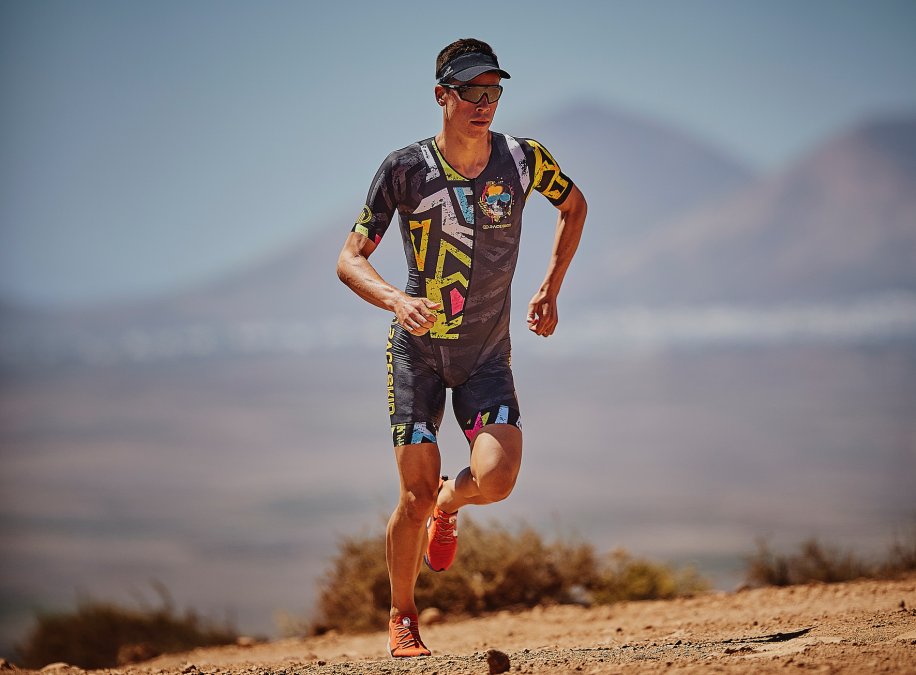
A proper fit for triathlon race suits describes sizing that follows your body's contours closely enough to eliminate flapping fabric without restricting movement, sitting flush against the torso, shoulders and thighs while allowing full range of motion through the swim stroke, pedal stroke and run stride.
Raceskin builds tri suits around this principle: the Elite and Aero suits use a close-cut pattern with a Teflon coating that helps the fabric move through water and dry quickly.
A second skin fit is not the same as a tight fit. A suit can feel tight and still fit badly: if it pulls across the shoulders or rides up at the crotch, it's too small in the wrong places. Compression should come from the fabric's elasticity, not from cutting off circulation.
Triathlon Suit Sizing Guide: How to Measure Yourself
Measure yourself in a tri suit or minimal clothing, using a soft tape measure held level and snug against the skin. Take each measurement twice and record the larger figure, because fabric has less give than skin.
Key Measurements to Take
- Chest: around the fullest part, tape level under the arms
- Waist: at the natural crease when you bend sideways
- Hips: around the widest point of the seat
- Torso length: from the shoulder seam down to the crotch, taken standing straight
- Inseam: from the crotch to just above the ankle bone
- Thigh circumference: at the widest point, relaxed
Torso length is the measurement most triathletes skip, and it causes the most grief: a long torso means shoulder straps digging in and fabric pulling at the chamois, while a short torso means bunching at the waist.
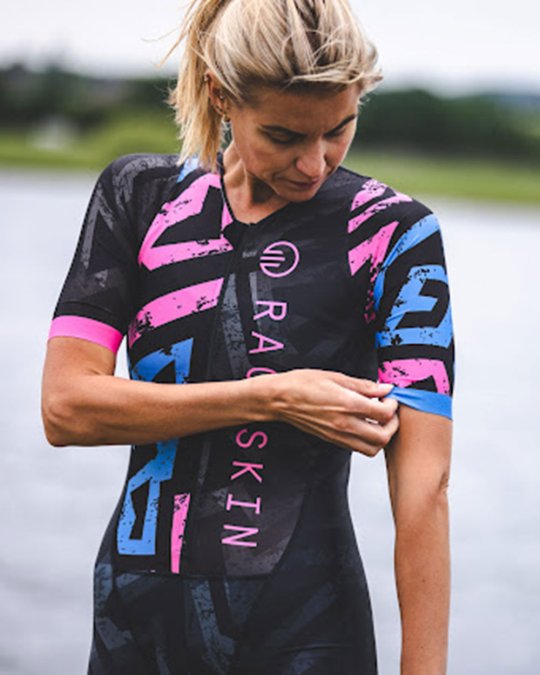
Female Elite Tri Suit
How Tight Should a Triathlon Race Suit Fit?
A triathlon race suit should feel compressive but never painful, with no fabric you can pinch more than a centimetre from the body. You should breathe deeply, rotate your arms through a full swim stroke, and stand upright without the suit pulling at the shoulders.
Most athletes test fit standing still in a shop, which tells you almost nothing about race pace. What follows is a movement-based protocol you can run at home in about fifteen minutes.
The at-home fit testing protocol
Run these tests in order, wearing the suit as you would on race day. If a test fails, note which dimension failed before adjusting size, because the fix is often a different cut rather than a different size.
1. The overhead reach (swim check)
Raise both arms overhead, then rotate each arm through a full circle as if completing a swim stroke. Watch whether the leg grippers move, the armhole cuts into the armpit, or the shoulder straps dig in.
A suit that passes lets your arms move without dragging the rest of the suit with them; one that fails restricts your stroke and chafes under the arm within the first kilometre.
2. The deep squat (bike check)
Squat to full depth with your feet flat. The chamois should stay in place, not slide forward or bunch, and the leg grippers should stay put on the thigh.
This simulates the hip angle you hold on the bike. A chamois that shifts in a squat will shift on the saddle, where most saddle discomfort originates.
3. The forward fold (run check)
Bend forward at the waist as if reaching for your toes. The back panel should not gape from your spine, and the waist should not ride up.
A gaping back panel catches air on the bike and rubs on the run; a waist that rides up means the torso is too short.
4. The stride and lunge (run check)
Take a few strides in place, then step into a deep lunge on each side. Check the inner thigh seam doesn't dig in and the leg grippers don't migrate upward.
The inner thigh is the highest-friction area on the run; a seam that digs in a lunge will chafe badly by the final leg.
5. The twist and reach (transition check)
Twist your torso to each side as if reaching for a shoe behind you, then reach down as if pulling on a wetsuit. Check the suit doesn't restrict your range of motion at the waist.
Transitions demand more movement than any single discipline. A suit that restricts you here will slow you down in T1 and T2.
What each failure tells you
- Grippers move on overhead reach: the suit is too short in the torso or too loose at the leg opening.
- Chamois shifts on squat: the suit is too loose through the hips or the chamois is positioned for a different anatomy.
- Back panel gapes on forward fold: the suit is too large in the chest or too long in the torso.
- Inner thigh seam digs in on lunge: the cut is wrong for your thigh circumference, not the size.
- Armhole restricts on twist: the suit is too small in the chest or the armhole pattern is wrong for your shoulder width.
Testing in all three disciplines
If you can, follow the at-home protocol with a short swim, a trainer session and a run before race day. The at-home tests catch most fit failures, but chlorine, sweat and sustained position changes reveal things a living room cannot: a suit that passes at home can still fail at hour three on the bike when you're wet and the fabric is under load.
Triathlon Suit Chafing Prevention: Seams, Chamois and Friction Points
Chafing comes from three things: movement between fabric and skin, raised or poorly placed seams, and a chamois that shifts under load. Reducing all three is a fit problem before it's a product problem.
Flatlock seams are the baseline. They sit flush rather than raised, so there's nothing to rub. Where those seams land matters just as much: the inner thigh, underarm and neckline are the friction points that ruin long-distance races.
The chamois is the other half. An ultra-thin, fast-drying chamois gives enough padding for the bike leg without holding water through the swim or bunching on the run, while a thick, absorbent pad becomes a sponge by kilometre 40.
Fit controls the rest: a suit that's too loose slides against the skin with every pedal stroke, and one that's too tight pulls the chamois out of position. Either way, you're raw by the run.
Triathlon Race Suit Aerodynamics: Why Fit Matters
A proper fit for triathlon race suits is the biggest aerodynamic variable you control, and it costs nothing to get right. Flapping fabric creates drag no helmet or wheel upgrade can offset, while a suit that sits flush lets air travel cleanly over your back and shoulders.
This is where the second skin principle earns its keep. Loose material at the shoulders and upper back catches air in exactly the position you spend most of the bike leg holding. Wrinkles across the chest do the same. Both are fit failures, not fabric failures.
Elasticity matters too: a suit with good four-way stretch holds its shape in an aero position rather than rippling, and compression through the thighs and core supports muscle groups across a long effort. Securing these technical advantages relies on precise measurements, and achieving perfect fit remains the most effective way to ensure your gear performs as intended throughout the race.
Before you spend on aerodynamic equipment, make sure your suit isn't working against you.
One-Piece vs. Two-Piece: Fit Differences That Matter
One-piece suits give a cleaner aerodynamic profile and eliminate the waist gap, but demand a more accurate torso length measurement. Two-piece suits are more forgiving across body types and easier for toilet stops, at the cost of a slight waist gap and small aerodynamic penalty.
Feature |
One-Piece |
Two-Piece |
|---|---|---|
Aerodynamics |
Cleaner profile, no waist gap |
Small gap at the waist |
Fit tolerance |
Less forgiving on torso length |
More forgiving |
Toilet stops |
Awkward |
Straightforward |
Transition speed |
Faster, nothing to align |
Slightly slower |
For sprint and Olympic distance, the one-piece usually wins. For Ironman distance, a sleeved tri suit for aerodynamics and comfort but for athletes whose torso length sits outside the middle of the size chart practicality sometimes tip the balance toward a two-piece.
Try both if you can, the difference is obvious within thirty seconds.
Fit Adjustments for Different Body Types
Standard size charts are built around a single average build, so most athletes are fitting two or three dimensions rather than one. The fix is to identify which dimension drives your fit, size to that, then check the others don't fail. Below are the most common patterns and the adjustment each needs.
Long torso
A long torso is the most common cause of a suit that fits the chest but fails everywhere else: shoulder straps dig in when you stand upright, and fabric pulls at the chamois on the bike.
The adjustment: size up one step, then check the chest and waist aren't now too loose. If sizing up makes the torso too baggy, look for an extended torso panel rather than a standard cut. Two-piece suits handle a long torso better because the waist can sit lower without dragging the shoulders down.
Short torso
A short torso produces the opposite problem: bunching at the waist and a chamois that sits too low. Sizing down to fix the bunching makes the chest and shoulders too tight, so don't do it.
The adjustment: look for a shorter torso panel or a two-piece where top and bottom can be sized independently. If between sizes on a one-piece, size to the torso rather than the chest, a loose chest is a smaller problem than a chamois that won't stay in place.
Broad shoulders, narrow waist
This build fails at the armholes and the waist simultaneously. Sizing to the shoulders leaves the waist gaping; sizing to the waist restricts the armholes.
The adjustment: size to the chest and shoulders, then check the waist doesn't gape more than a centimetre when you bend forward. A two-piece is almost always better here; if you're committed to a one-piece, look for a higher waist seam or a drawcord.
Muscular thighs
Thigh circumference is the measurement most athletes ignore, and it causes leg grippers to roll, ride up or cut in during the run.
The adjustment: measure your thigh at the widest point and compare it against the suit's leg opening specification, not just the size chart. If between sizes on the leg opening, size up and accept a slightly looser torso, because a gripper that rolls will chafe for the entire run leg.
Larger build
Sizing purely on the chest often produces a suit that's too loose through the legs and too tight at the armholes. The two failure points are leg gripper tension and armhole fit.
The adjustment: prioritise leg gripper tension and armhole comfort over chest measurement. A suit that rides up during the swim or bunches at the hips costs more time than a slightly looser chest. Look for a wider gripper band, which distributes pressure better than narrow elastic.
Between sizes
The general rule is to size up for long distance and down for sprint racing, but the more useful test is which dimension is failing. Tight at the shoulders and armholes? Size up. Loose at the waist and grippers? Size down. If both are true, the cut is wrong for your body, not the size.
Common Fit Mistakes to Avoid
The most expensive fit mistake is buying for how a suit feels standing still. A suit that feels perfect in a shop mirror can be unusable at race pace.
- Sizing down for "compression". Compression comes from fabric, not a suit that's too small. Sizing down pulls the chamois out of place and restricts your swim stroke.
- Ignoring torso length. Chest and waist measurements alone won't tell you whether the shoulder straps will dig in.
- Never testing in all three disciplines. Swim, bike and run place completely different demands on a suit. Test all three before race day.
- Racing in a suit past its life. Elasticity fades with chlorine, sun and washing. A suit that fitted perfectly two seasons ago may now be loose at the shoulders and grippers, reintroducing drag and chafing.
- Assuming your old size still applies. Body composition changes between seasons. Re-measure before every major purchase.
Getting fit right is the cheapest performance gain in triathlon, and the one most athletes rush. Raceskin builds tri suits with a second skin cut, flatlock seam placement and an ultra-thin fast-drying chamois, tested in real training and racing conditions. The Men's Elite Tri Suit and Women's Elite Tri Suit both use a Teflon coating for faster water passage and quicker drying, while the Men's Aero Tri Suit was rated 'Best On Test' by 220 Magazine. If you're kitting out a club, Raceskin's dedicated designer handles custom team apparel from sizing through to the start line. Get race ready with Raceskin.

Frequently Asked Questions
Do you wear underwear under a triathlon suit?
No, you should not wear underwear under a triathlon suit. Tri suits are designed to be worn directly against the skin, with a thin chamois that works best without extra layers. Wearing underwear underneath can cause chafing, trap moisture, and create uncomfortable bunching during the swim, bike, and run. The moisture-wicking performance fabric is made to manage sweat and water on its own, so adding cotton or synthetic underwear only works against those properties. Choose a suit with flatlock seams and a chamois that suits your race distance for the best result.
What are the common signs of a poorly fitted tri suit?
A poorly fitted tri suit shows clear warning signs: fabric that flaps or billows on the bike, seams that dig into your shoulders or hips, and a chamois that shifts during the ride. You may also notice restricted arm movement during the swim, a neckline that rubs, or leg grippers that ride up. Any of these points to a sizing or cut problem. If you can pinch more than a couple of centimetres of loose fabric at the torso, or if you feel pressure points after 20 minutes of wear, the fit is wrong and chafing or drag will follow.
Should a tri suit feel different when swimming versus cycling?
Yes, a tri suit should feel different across each discipline. In the swim, you want a snug, second-skin fit with no fabric that catches water, but your arms and shoulders need full range of motion for the stroke. On the bike, the suit should stay put without shifting, and the chamois should sit comfortably against the saddle. On the run, the fabric needs to move with you without chafing. A well-designed tri suit balances all three, so test your suit in each discipline before race day rather than judging the fit from a single try-on.
How does a race suit fit affect aerodynamics?
Fit has a direct effect on triathlon race suit aerodynamics. Loose fabric creates flapping and turbulence, which increases drag and costs you time on the bike leg. A snug, second-skin fit smooths airflow over your body and reduces resistance. Seam placement matters too, because raised or poorly positioned seams disrupt airflow. Raceskin suits are engineered as a second skin with Teflon coating to help you cut through water and air, then dry quickly for the next discipline. The tighter the fit, the lower the drag, provided it does not restrict your movement.