

Table of Contents
- Why Sighting Matters in Open Water
- The Crocodile Technique vs. Head Lift Sighting
- How to Time Sighting with Your Breathing Pattern
- Selecting Fixed Landmarks for Navigation
- Open Water Swimming Drills for Beginners
- How to Improve Shoulder Mobility for Swimming
- Open Water Swimming Sighting Frequency and Course Correction
- Common Mistakes When Sighting
- Frequently Asked Questions
Last Updated: September 22, 2026
Why Sighting Matters in Open Water
The skill of sight in open water swimming keeps you moving straight toward the finish line instead of veering off course. Without it, even strong swimmers waste energy swimming in the wrong direction.
Most pool swimmers never develop this skill. The pool walls and lane lines do the navigation work for them. But open water has no boundaries. A triathlon buoy might be 500 metres away. A lake shore is just a blur of trees. You need to know where you're going, and you need to check constantly without slowing down.
Poor sighting costs you time and mental energy. You might swim 50 metres off course without realising it. Then you have to correct, which means extra distance and extra fatigue when you're already tired. The psychological impact matters too. Uncertainty about direction creates anxiety. Anxiety burns energy. Energy is what you need to finish strong.
Sighting isn't complicated. It's a simple technique you can learn in a pool and refine in open water. The key is timing it with your breathing pattern so it doesn't disrupt your stroke rhythm or slow you down.
The Crocodile Technique vs. Head Lift Sighting
Two main methods exist for achieving sight in open water swimming. Understanding the difference helps you choose the approach that fits your stroke and breathing pattern.
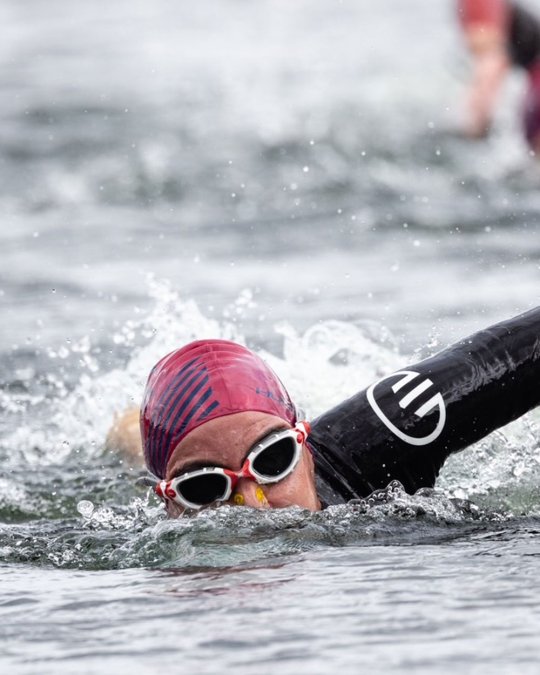
The crocodile technique keeps your head low. Your eyes break the water surface just enough to see forward. Your chin stays in the water. Your head barely rotates. This method minimizes drag and disruption to your stroke rhythm. It works well if you're already comfortable with bilateral breathing and good head position.
Head lift sighting lifts your head higher out of the water. Your eyes and forehead clear the surface fully. You get a clearer view of distant landmarks. The trade-off is more drag and more disruption to your stroke. Your body position changes. Your legs drop slightly. Your forward momentum slows.
Most experienced open water swimmers prefer the crocodile technique because it preserves hydrodynamics and stroke efficiency. You maintain your body alignment and buoyancy. The head lift works better for beginners who feel anxious about direction or for swimmers in rough water where visibility is poor.
The real difference comes down to your comfort level and what your stroke can handle. A strong swimmer with good body position and torso rotation can use the crocodile method without any loss of speed. A less experienced swimmer might find the head lift more reliable, even if it costs a few seconds per lap.
Practice both in the pool. See which one feels natural with your breathing pattern. Then commit to one in open water. Switching between techniques mid-race wastes mental energy.
How to Time Sighting with Your Breathing Pattern
Sighting and breathing happen at different moments in your stroke cycle. Timing them correctly means you sight without gasping or losing rhythm.
Most swimmers sight every 6 to 8 strokes. This frequency keeps you on course without constant checking. Some swimmers sight every 4 strokes if they're in rough water or unfamiliar territory. Others sight every 10 strokes if conditions are calm and landmarks are clear.
The key timing principle: sight when you're about to breathe, but before you inhale. Here's how it works:
- Complete your stroke cycle normally
- As you rotate your torso for the next breath, glance forward instead of to the side
- Your head lifts slightly (crocodile) or more fully (head lift)
- You see the landmark or buoy ahead
- Your head returns to neutral
- Then you breathe normally on your next stroke
This timing means sighting takes almost no extra time. You're already lifting your head to breathe. You're just changing the direction you look.
The mistake many swimmers make is sighting on a stroke where they're not breathing. This breaks your rhythm and forces an extra head lift. Your stroke becomes choppy. Your legs drop. You lose speed.
Practice this timing in the pool first. Swim 25 metres and sight every 6 strokes, always timing it with a breath. Feel how it integrates into your stroke. Once it's automatic, you won't think about it in open water. Clear vision remains essential for maintaining this rhythm, especially when glare or water conditions necessitate the use of prescription sports sunglasses to keep your landmarks in focus.
Selecting Fixed Landmarks for Navigation
The best landmarks are tall, fixed objects that won't move between the time you sight them and the time you reach them. Trees, buildings, and hills work well. Buoys work perfectly because they're designed for this purpose.
Avoid landmarks that move or change. Other swimmers, boats, and clouds are unreliable. A cloud drifts. A swimmer moves. You'll follow them off course.
In a race, the course is marked with buoys. Your job is simple: aim for the next buoy. Sight it every 6 to 8 strokes. When you reach it, the next buoy becomes your target. Repeat until the finish.
In open water training without marked buoys, pick landmarks on shore. A tall tree. A church steeple. A distinctive rock formation. Something you can see clearly from water level.
Distance matters. A landmark that's easy to see from 50 metres away might disappear when you're 10 metres away and looking up at a low angle. Pick landmarks that remain visible as you approach.
Navigation tips for open water:
- Pick 2 or 3 landmarks in a line if possible (one near, one far, one very far)
- This gives you multiple reference points and confirms your direction
- If the near landmark disappears, you still have the far ones
- Adjust your course if the near landmark drifts to your left or right
- Small corrections early prevent big detours later
Open Water Swimming Drills for Beginners
Drills build the skills you need for confident sighting. Start in a pool where it's safe to experiment and fail.
Drill 1: Sighting without breathing (25 metres)
Swim normally and sight every 6 strokes without taking a breath when you sight. Just lift your head, look forward, and return to neutral. Your next breath comes on the normal stroke. This separates the sighting motion from the breathing motion so you can perfect each one independently.
Drill 2: Sighting with breathing (50 metres)
Now combine them. Sight on the stroke where you breathe. Time your head lift so you see the target as you rotate for air. Breathe normally. This is the real-world timing you'll use in open water.
Drill 3: Landmark navigation (pool length)
Place a kickboard or small object at the far end of the pool. Swim toward it and sight every 6 strokes. Keep your eyes on the target the entire swim.
Drill 4: Bilateral sighting (50 metres)
How to Improve Shoulder Mobility for Swimming
Shoulder mobility affects how high you can lift your head and how easily you can rotate your torso. Better mobility means easier sighting with less disruption to your stroke.
Mobility work for swimmers:
- Shoulder circles: 10 forward, 10 backward, daily
- Doorway chest stretch: 30 seconds each side, 3 times per week
- Sleeper stretch: 30 seconds each side, 3 times per week
- Band pull-aparts: 15 reps, 3 times per week
- Scapular wall slides: 15 reps, 3 times per week
Open Water Swimming Sighting Frequency and Course Correction
How often you sight depends on conditions and your comfort level. Calm, clear water with visible landmarks requires less frequent sighting. Rough water with poor visibility requires more.
Sighting frequency guidelines:
- Calm, clear conditions: every 8 to 10 strokes
- Moderate conditions: every 6 to 8 strokes
- Rough or poor visibility: every 4 to 6 strokes
- First open water experience: every 4 strokes
Course correction technique:
Common Mistakes When Sighting
Most sighting mistakes happen because swimmers either sight too infrequently, time it poorly with breathing, or lose focus on their landmarks.
Mistake 1: Sighting too infrequently
Mistake 2: Sighting on non-breathing strokes
Mistake 3: Losing your landmark
Mistake 4: Sighting too high
Mistake 5: Not practicing in the pool
Mistake 6: Ignoring goggle maintenance
Frequently Asked Questions
How often should you sight when open water swimming?
Sighting frequency depends on water conditions, course familiarity, and your stroke rhythm. Most swimmers sight every 6–8 strokes in calm, familiar waters. In choppy conditions or unfamiliar courses, increase to every 4–6 strokes. During triathlon training, practise sighting every 6–8 strokes to maintain stroke efficiency whilst staying on course. Bilateral breathing naturally supports regular sighting without disrupting your rhythm.
What's the best technique for sighting without breaking your stroke rhythm?
The crocodile technique minimises disruption: lift your eyes just above the water surface as your head naturally rotates during bilateral breathing, rather than lifting your entire head. This keeps your hips high, reduces drag, and maintains buoyancy. Time your sight with an exhale or during your breathing rotation. Practise in a pool first to build muscle memory so sighting becomes automatic and doesn't interrupt your stroke efficiency or navigation.
Can I practise sighting in a pool before heading to open water?
Absolutely. Pool drills are essential for beginners. Pick a fixed object across the pool and sight it every 6–8 strokes, focusing on minimal head movement. Practise with your wetsuit if you'll wear one in open water, since buoyancy and body position differ. Drill sighting during your normal training sessions to build confidence and refine your technique. This preparation significantly reduces anxiety when you transition to open water and helps you maintain a straight line during your first swims.
What should I do if I can't see clearly due to glare or water conditions?
In choppy or glary conditions, sight more frequently (every 4–6 strokes) to stay oriented. Position yourself slightly wider of your landmarks to account for drift. Ensure your goggles are clean and free of scratches before each swim—goggle clarity directly affects your ability to spot landmarks and navigate accurately. If glare is severe, adjust your sighting angle slightly or use landmarks at different heights (buoys, trees, buildings) to triangulate your position and maintain course.