

Table of Contents
- Why Ironman Chafing Happens and How to Stop It
- Best Anti-Chafing Cream for Triathletes: What to Look For
- How to Prevent Wetsuit Neck Chafing Before the Swim
- Triathlon Clothing Comfort Tips for the Bike Leg
- Run Leg Friction Points and Reapplication Strategy
- T1 and T2 Transition Tactics to Minimise Skin Damage
- Common Mistakes to Avoid on Race Day
- Conclusion
- Frequently Asked Questions
Last Updated: September 9, 2026
Why Ironman Chafing Happens and How to Stop It
Chafing during an Ironman results from repetitive friction combined with moisture and salt crystals, breaking down the skin's outer barrier over 8 to 17 hours (peer-reviewed research). Each discipline introduces different friction points: the wetsuit neck and shoulders in the swim, the chamois and seams on the bike, and the repetitive motion of the run. To prevent chafing effectively, treat it as a gear and preparation issue rather than something to manage mid-race.
Our approach is built on prevention starting before you enter the water, combining seam-conscious apparel with a strong anti-chafe balm applied to every known friction zone. This guide covers the specific products, application points, and race-day tactics that keep your skin intact from swim start to finish line.
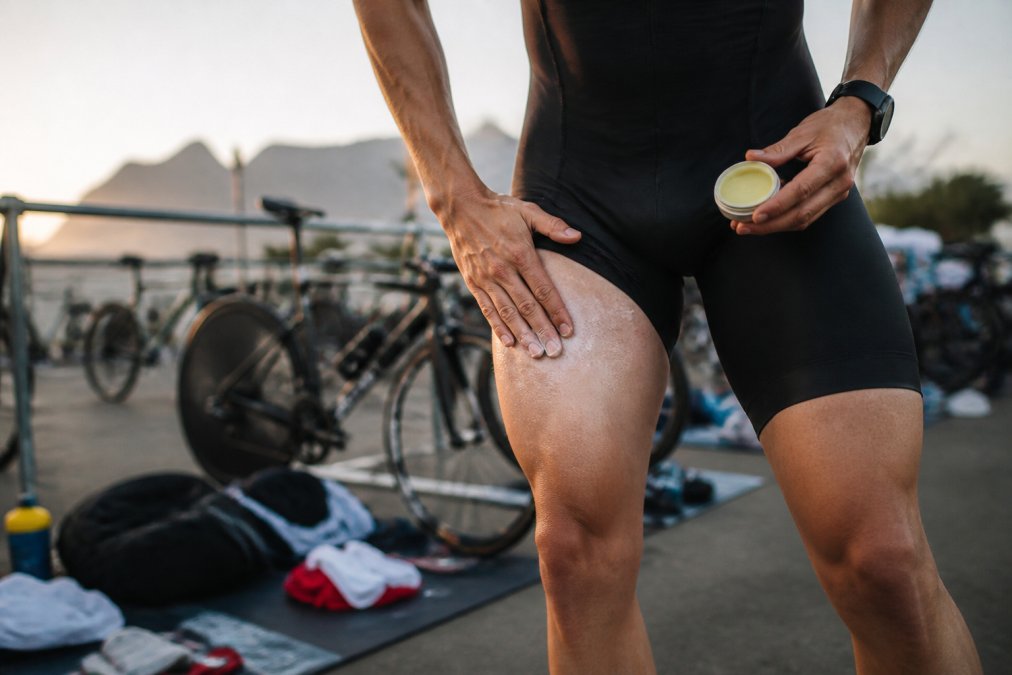
Best Anti-Chafing Cream for Triathletes: What to Look For
The best anti-chafing cream for triathletes is waterproof and sweat-resistant, maintaining a durable lubricating film through the swim and hours of effort. Its primary goal is to reduce friction while creating a protective barrier against moisture, the primary catalyst for maceration. A product that washes off in the first 500 metres of the swim offers no protection for the 180km bike leg.
Silicone-Based vs. Lanolin-Based Balms
Choosing between silicone-based and lanolin-based balms depends on your skin sensitivity and the specific friction points you are targeting.
- Silicone-based balms are hydrophobic and create an ultra-slick, long-lasting barrier that is highly effective against wet friction, such as wetsuit neck chafing. They are generally odourless and less likely to cause skin reactions, making them ideal for those with sensitive skin.
- Lanolin-based balms are thicker and provide a strong, cushioning barrier that excels at protecting against the high-pressure, repetitive friction of the bike saddle. However, lanolin is a common allergen, and its thick consistency can be difficult to wash out of tri-suits (the American Academy of Dermatology).
How to Prevent Wetsuit Neck Chafing Before the Swim
To prevent wetsuit neck chafing, address the area where the wetsuit collar rubs against the skin, typically the back of the neck and collarbones. This friction is exacerbated by the constant rotation of the shoulders during the swim stroke. The solution is a dual approach: ensure a proper wetsuit fit and apply a thick layer of anti-chafe balm to the neck before putting on the suit.
A common mistake is applying balm only to the skin and not to the inside of the wetsuit collar. Apply a generous strip to the neoprene edge as well, creating a buffer zone between the two surfaces. This is critical to prevent chafing during ironman events, as neck irritation can become a significant distraction on the bike and run.
Triathlon Clothing Comfort Tips for the Bike Leg
The bike leg presents unique challenges because your position is fixed for hours, concentrating pressure and friction on the sit bones, inner thighs, and lower back. Triathlon clothing comfort tips for the bike leg centre on the interaction between your tri-suit's chamois and your skin, not just the padding itself. A high-quality tri-suit should fit like a second skin, with flatlock seams that do not dig into the skin under pressure.
The Material Science of Tri-Suits: Beyond the Chamois
Most guides stop at recommending a good chamois, but the real friction battles are won or lost in the fabric and construction of the suit itself. Understanding these technical fabrics is key to preventing chafing over 180km.
- Fabric Breathability and Moisture Management: Look for suits with laser-cut perforations or open-mesh panels in high-sweat zones like the lower back and underarms. These allow sweat to evaporate rather than pooling against the skin. A suit that traps moisture against the skin creates the perfect environment for maceration, where the skin softens and becomes more susceptible to tearing. The best fabrics wick moisture away and dry quickly, such as recycled nylon or polyester blends with a hydrophobic treatment.
- Seam Placement and Construction: The location of seams is arguably more critical than the fabric itself. A poorly placed seam under the sit bone or along the inner thigh can act like a saw blade over 180km of pedalling. Look for suits that route seams away from these high-pressure zones, often using a 'race cut' that positions seams towards the front or back of the leg. Flatlock seams are essential, as they lie flat against the skin and eliminate the raised ridge of a standard overlock seam. Some premium suits even use bonded or taped seams, which remove the stitching entirely from the skin contact surface.
- The Chamois's Role in a System: The chamois is not an isolated pad; it is part of a system that includes the suit's compression and the rider's position. A chamois that is too thick can create its own friction points by bunching or moving against the skin. The ideal chamois for an Ironman is multi-density, with firmer foam under the sit bones and softer, more flexible material at the edges to prevent it from digging in. It should also have a smooth, non-absorbent top layer that allows the skin to glide over it rather than stick and pull.
The 'Second Skin' Fit Principle
A tri-suit fitting like a 'second skin' is a functional requirement, not a marketing phrase. A suit too loose will shift and bunch; one too tight restricts movement and creates pressure points. The correct fit is snug but not restrictive, with leg grippers holding firmly without deep marks, and no pulling across the shoulders or fabric folds at the waist in the aero position. This is why a professional fit or detailed size guide based on your measurements is crucial.
Chamois Cream and Seam Placement
Chamois cream is a specialised anti-chafe balm for cycling's high-friction environment, often containing antibacterial agents to prevent folliculitis from prolonged saddle pressure (the CDC). Apply it liberally to the perineal area and sit bones so the chamois moves against the cream rather than your skin. Seam placement is equally critical; a single poorly placed seam can cause severe irritation over 180km.
Run Leg Friction Points and Reapplication Strategy
The run leg shifts friction points from the saddle to the feet, nipples, and underarms, where repetitive motion causes the most damage. While the bike is about pressure, the run is about continuous abrasion. Sweat mixed with salt crystals creates a sandpaper effect, demanding a reapplication strategy to maintain the skin barrier; you cannot rely on pre-swim balm to last the entire race.
The Physiological Factors: Hydration, Salt, and Skin Integrity
The severity of run chafing is profoundly influenced by your physiological state, not just mechanical clothing friction. Two athletes in the same kit can have vastly different experiences based on how their bodies manage sweat and hydration.
- Sweat Composition and Salt Buildup: Sweat is not just water; it contains electrolytes, primarily sodium chloride. As sweat evaporates on your skin, it leaves behind salt crystals. These crystals are abrasive and dramatically increase the friction coefficient between your skin and your tri-suit or race belt. Athletes who are 'salty sweaters', those who notice white residue on their skin or clothing after a long run, are at a significantly higher risk of chafing. This is why simply reapplying balm over a sweaty, salty leg is ineffective; you are trapping the abrasive crystals against your skin.
- Hydration Status and Skin Turgor: Dehydration reduces skin elasticity and turgor, making it less resilient to shear forces. When skin is dehydrated, it is more prone to micro-tears and irritation. Maintaining proper hydration throughout the bike leg is a preventative measure for the run. A well-hydrated athlete has skin that can better withstand the repetitive friction of the marathon.
- The 'Sandpaper Effect' in Practice: Consider the difference between rubbing your arm with a dry towel and a damp, salty towel. The latter is far more abrasive. This is the exact condition on your inner thighs and underarms after 5-6 hours of sweating on the bike. The reapplication strategy must therefore begin with removing the salt, not just adding more lubricant.
Gender-Specific Friction Points on the Run
While the general principles of chafing prevention apply to all athletes, the specific friction points and the solutions differ significantly between men and women.
- For Men: The most common and severe friction point is the nipples. The repetitive motion of the run causes the shirt or tri-suit top to rub against the nipples, leading to bleeding in extreme cases. While balm can be applied, many male triathletes find that a dedicated product like nipple patches or medical tape (e.g., micropore tape) is more reliable. The tape provides a physical barrier that does not wash away with sweat. Another key area is the inner thigh, where the leg's natural gait cycle can cause skin-on-skin friction, especially if the tri-suit shorts have a shorter leg length.
- For Women: The friction points are more varied and often overlooked in generic guides. The underwire or seam of a sports bra can cause severe chafing under the breasts and along the ribcage. The bra's lower band is a common culprit, especially if it shifts during the run. A well-fitted, seamless sports bra is essential. Additionally, the area where the tri-suit's leg grippers sit can rub against the upper inner thigh, and the seams of the chamois can irritate the labia or perineal area. For women, applying a thick, barrier-style balm (often lanolin-based) around the bra line and the edges of the chamois is critical. Some female athletes also find that a longer-leg tri-suit short provides more protection against inner-thigh rub.
A Physiological Reapplication Strategy for T2 and Beyond
Given these factors, the reapplication strategy must be more sophisticated than simply 'put on more balm.'
- T2 Reset: Before applying any new balm, take a clean towel and firmly wipe down the key friction zones: inner thighs, underarms, and for men, the chest. This physically removes the salt crystals and surface moisture. If you have a water bottle, a quick rinse of the area can be even more effective, but ensure you dry thoroughly before applying balm.
- The First 5km: The first few kilometres of the run are when your body is transitioning from the bike's fixed position to the run's upright gait. Your core temperature is still high, and you will continue to sweat. The balm applied at T2 needs to be thick and durable enough to survive this initial sweat flush.
- Mid-Marathon Check: At the halfway point (around the 21km mark), assess your hot spots. If you feel any new friction developing, this is the time to reapply. Carry a small, travel-sized balm in your race belt or a pocket. For the run, focus on the inner thighs, underarms, and any area where your tri-suit or race belt creates a seam. To prevent chafing effectively during the run, the balm must be sweat-resistant enough to survive the early kilometres while your core temperature is still rising.
T1 and T2 Transition Tactics to Minimise Skin Damage
Transition zones are where most athletes make critical errors leading to chafing later in the race. In T1, aggressively pulling off the wetsuit can strip away the protective balm on your neck and shoulders. Use a wetsuit stripper or take extra seconds to peel the suit down carefully, preserving the lubricant layer beneath.
T2 presents a different problem: skin is wet with sweat, making balm application over wet, salty skin less effective. Before applying fresh anti-chafe balm, quickly wipe key friction zones with a towel to remove salt crystals and moisture, re-establishing a clean, dry base. These tactics are essential to prevent chafing during the run leg.
| Race Phase | Primary Friction Points | Recommended Action |
|---|---|---|
| Swim (T1) | Neck, shoulders, underarms | Apply thick balm layer pre-swim; remove wetsuit carefully to preserve it |
| Bike | Sit bones, inner thighs, lower back | Use chamois cream; ensure tri-suit seams are routed away from pressure zones |
| Run (T2) | Inner thighs, underarms, nipples | Wipe away salt crystals, then reapply fresh sweat-resistant balm |
Common Mistakes to Avoid on Race Day
Several common mistakes can undermine your race-day chafing prevention strategy. The most frequent is testing new gear or balms for the first time during the race; a severe skin reaction mid-race can end your day. Always train with your race-day lubrication and clothing combination to confirm compatibility.
Another mistake is under-applying the balm; most athletes use far too little, assuming a thin layer suffices. For an Ironman, you need a visible, opaque layer on high-friction zones, not a sheer film. Finally, do not ignore early warning signs like a hot spot or slight sting, addressing it at an aid station is far easier than managing a full abrasion in the final 10km.
Conclusion
Preventing chafing during an Ironman is a matter of meticulous preparation, not luck. It requires pairing high-quality, seam-conscious apparel with the correct anti-chafe balm, applied generously and reapplied at the right moments. By understanding where friction occurs in each discipline and respecting transitions, you protect your skin barrier and preserve energy for a strong finish.
We engineer our tri-suits with flatlock seams and materials tested in long-duration events, designed to work in concert with your lubrication strategy. Get race ready with apparel that supports your comfort, allowing you to focus entirely on your performance.
Frequently Asked Questions
How do triathletes avoid chafing during long-distance races?
Triathletes prevent chafing by combining three tactics: using a high-quality anti-chafe balm on known friction zones, wearing a tri-suit that fits snugly without excess material, and practising race-day nutrition and hydration to avoid salt crystal buildup on the skin. Applying balm to the neck, armpits, inner thighs, and chamois edges before the swim is standard practice. Reapplying during transition, especially before the run leg, is essential for races lasting over five hours.
What is the best anti-chafing cream for triathletes?
The best anti-chafing cream for triathletes is one that is waterproof, sweat-resistant, and silicone-based. Silicone provides a longer-lasting barrier than water-based formulas, which wash off in the swim. Look for a balm that contains no petroleum jelly if you are wearing a wetsuit, as it can degrade neoprene over time. A product with a solid stick format is practical for carrying in a transition bag for quick reapplication on the run leg.
How can I prevent wetsuit neck chafing?
To prevent wetsuit neck chafing, apply a thick layer of anti-chafe balm to your neck and collarbone before putting on your wetsuit. Ensure the wetsuit collar fits snugly without gaping, as a loose collar allows water and sand to enter, increasing friction. A triathlon-specific wetsuit with a soft inner lining on the collar reduces irritation. During the swim, maintain good body position to minimise repetitive neck movement against the suit.
Does clothing choice impact chafing during an Ironman?
Yes, clothing choice is the primary factor in chafing during an Ironman. A tri-suit made from moisture-wicking, seamless fabric reduces friction points compared to standard sportswear. Flatlock or bonded seams prevent seam rubbing on the skin. The chamois pad should be thin and correctly positioned to avoid bunching on the bike. Avoid cotton entirely, as it retains moisture and increases skin maceration, leading to irritation over 140.6 miles.
Chafing is a solvable problem, but it demands that you treat your skin as a critical piece of race equipment. The right combination of a durable, sweat-resistant balm and a well-fitted tri-suit is the foundation of any successful long-distance race. Get started with Raceskin and experience gear engineered for the full distance.