

Last Updated: September 11, 2026
Custom Kit Lead Times: What to Expect
Most clubs asking how long do custom kits take are really asking: will the kit arrive before the event? A standard custom kit order runs through design, approval, manufacturing, quality checks and dispatch, and the total window depends far more on how quickly your club signs off on artwork than on how fast a factory can sew. At Raceskin, we build custom club and team apparel around that reality, with a dedicated designer who keeps the approval loop short. We typically deliver kit orders in 4-5 weeks, we have done it much quicker and sometimes it will take longer and there are various reasons that effect this timeframe.
Treat a custom kit order as a project with four phases: design, approval, manufacturing and delivery. Only manufacturing is genuinely fixed once production begins.
Custom Sports Kit Design Stages and Approval
The custom sports kit design stages are where most of the avoidable delay lives: brief, concept, revision, sign-off, then production release. Every day a club sits on artwork approval is a day added to the estimated arrival. Here is the sequence most clubs move through, with realistic durations when things run smoothly:
- Brief (1-3 working days), you supply club colours, logos, sponsor marks, sizing breakdown and design references. Incomplete briefs cause most later revisions: low-resolution logos or colours given as "roughly navy" force the designer to guess, and guesses get rejected.
- Concept (2-5 working days), the designer produces the first visual, usually a digital mock-up. Complex designs with gradients, custom patterns or multiple sponsor placements take longer than a two-colour jersey.
- Revision (1-3 working days per round), colours, placement and sizing charts are adjusted, and colour matching is confirmed. Most clubs need one or two rounds; three or more signals an unclear brief or too many approvers.
- Approval (your call, but aim for 48 hours), you sign off the final artwork. Nothing moves to manufacturing before this.
- Production release (same day), the approved file goes into the manufacturing queue, and the production clock starts.
The single biggest lever is speed at stage four. A club that approves artwork within 48 hours can pull a week or more out of the total timeline compared with one that takes a fortnight to gather committee sign-off.
What actually causes revision loops, in order of frequency:
- Low-resolution logos. A sponsor mark pulled from a website or WhatsApp cannot be reproduced cleanly at kit scale. Supply vector files (AI, EPS, SVG) or high-resolution PNGs with transparent backgrounds.
- Colour ambiguity. "Club blue" means different things to different people. Supply a Pantone reference or physical swatch; a designer matching to a phone screenshot will not match the fabric.
- Sizing spread. A club order needs a full size run confirmed before production, not after. Chasing 40 team members for sizes after approval adds days unrelated to design.
- Committee feedback. Every additional approver multiplies the revision rounds. This is the most common and most avoidable cause of delay.
Artwork complexity also feeds into manufacturing time. A single-colour design with a chest logo is faster to produce than a full sublimated pattern that wraps around the garment, because complex artwork means more setup and more careful quality checking. If your event date is tight, simplifying the design shortens the production phase, not just approval.
Treat the brief as a checklist completed before the designer starts: vector logos, Pantone or swatch colour references, confirmed size run, sponsor placements marked on a template, and a single named approver. Clubs that complete it typically reach approval in under a week; clubs that do not often take three.
Factors That Affect Delivery Speed
Several variables decide whether a custom kit lands early or late, and only some are within the supplier's control: order volume, fabric stock availability, the number of unique designs in one order, and the time of year.
Order volume cuts both ways. A large bulk order is more efficient per unit once batch processing begins, but takes longer to assemble, pack and dispatch. Multiple designs in one order add production stages because each design is effectively its own job.
Fabric sourcing matters more than most buyers realise. Standard technical fabrics are usually held in stock, but a bespoke colour or specialist performance fabric may need to be procured first. If your club has a fixed event date, choosing a fabric confirmed in stock removes a variable you cannot control.
Manufacturing, Fabric Sourcing and Quality Assurance
Once artwork is approved, the order moves into manufacturing: fabric is cut, sublimation or embroidery applied, panels stitched, and finished garments pass quality assurance before packing. This phase has the least flexibility, because production slots are booked in advance and a missed slot means waiting for the next one.
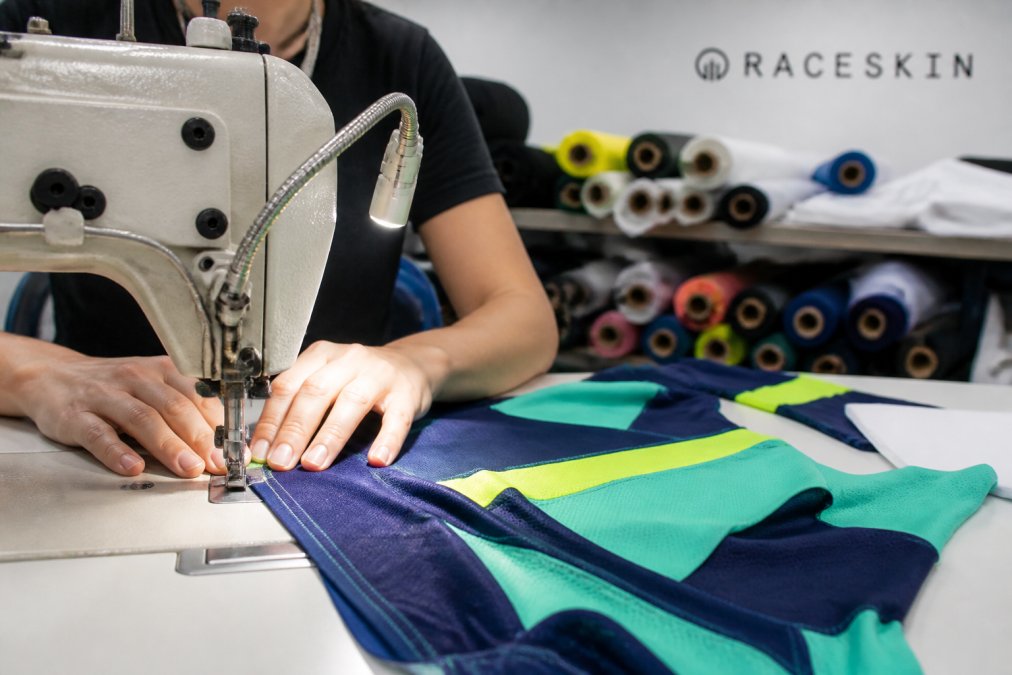
Close-up of a sewing machine stitching a colourful custom cycling jersey in a bright workshop, with rolls of technical fabric visible in the background
Sublimation, used for most full-colour custom kits, prints the design into the fabric rather than onto it, so colours do not crack or peel. Embroidery is used for logos on heavier garments and is slower per unit because each logo is stitched individually.
Quality assurance is the step buyers underestimate. A batch is checked for print accuracy, colour match against approved artwork, seam strength and sizing consistency before dispatch. Catching a fault here costs a day; catching it after the kit has been posted to 60 club members costs a full remake cycle.
Shipping, Dispatch and Order Tracking Milestones
Dispatch and shipping are separate clocks. Dispatch is when the order leaves the production facility; shipping transit is the time it spends getting to you. A kit can be dispatched on time and still arrive late if the shipping method was chosen without accounting for the delivery schedule.
The tracking milestones to watch for are:
- Order confirmation - your order and artwork are logged.
- In production - manufacturing has started.
- Quality checked - the batch has passed inspection.
- Dispatched - the parcel has left the facility and tracking is live.
- In transit - the parcel is moving through the courier network.
- Delivered - the kit has arrived.
Peak Season Delays and How to Beat Them
Peak season is the single biggest cause of extended lead times, and it is entirely predictable. Demand for custom teamwear clusters around the start of the competitive season, the run-up to major events and the pre-Christmas period, and factories fill their production slots weeks in advance.
The fix is to order early, earlier than feels necessary. If your season starts in spring, ordering in the quieter winter months secures a production slot before the queue builds. Clubs that order during peak season compete for the same capacity as everyone else, and the ones who ordered first get served first.
Rush Orders, Bulk Orders and Speeding Up Your Timeline
Most guides on custom kit lead times stop at "plan ahead". This section explains when a rush order is genuinely possible, when it is not, and which levers actually compress a timeline.
When a rush order is feasible
A rush order is not a product you can buy; it is a production slot that has to exist. Three conditions must all be true at once:
- Spare factory capacity. Production slots are booked in advance. If the factory is running at capacity, there is no rush slot to sell, regardless of budget.
- Fabric in stock. If the chosen fabric is a standard line held in stock, manufacturing can start immediately after approval. If it is a bespoke colour or specialist performance fabric, it has to be procured first, and that procurement time cannot be compressed.
- Artwork approved and final. A rush order with an unapproved design is not a rush order, it is a standard order with extra pressure. The production clock only starts at sign-off.
When all three line up, a rush order can meaningfully shorten production and dispatch. When any one is missing, no amount of urgency moves it. Before committing to a deadline, ask two questions: is there a confirmed production slot, and is the fabric confirmed in stock? If either answer is vague, treat the timeline as standard.
Bulk orders vs. individual orders
Bulk orders behave differently from individual orders, and the difference is counter-intuitive:
- Individual or small-run orders are often scheduled around larger production batches, so a single custom item can wait longer relative to its size. It fills gaps in the schedule rather than driving it.
- Bulk club or corporate orders (25+) are batch processed as one job once approved. Per unit they move faster through manufacturing than small runs, but take longer to assemble, pack and dispatch, and require a full size run and consolidated artwork before production starts.
- Multiple designs in one order add production stages, because each design is effectively its own job. Consolidating to a single design is one of the most effective ways to shorten a bulk timeline.
The levers that actually work
If you genuinely need to compress the timeline, these levers work, roughly in order of impact:
- Approve artwork within 48 hours of receiving the concept. The single biggest lever, and entirely within your control. Clubs that approve quickly routinely pull a week or more out of the total timeline.
- Choose fabrics confirmed in stock rather than bespoke options. This removes the one variable you cannot influence once the order is placed.
- Consolidate to a single kit item where possible, rather than splitting the order across multiple kit types.
- Confirm the full size run before approval, not after. Chasing sizes post-approval adds days unrelated to manufacturing.
- Order in the off-season, before peak demand fills production slots, the most reliable way to avoid a rush situation entirely.
- If it’s needed for a race, confirm your event date at the point of order so dispatch can be scheduled around it.
What rush orders cannot fix
Rush capacity is finite, and during peak season it is often already committed. Leaving the order until the event is close and then asking for a rush usually leaves only the shipping method as a lever, which affects transit time but not production time. If the production slot is not available, express shipping will not save the deadline.
Supply chain transparency matters most when a deadline is tight. Knowing which stage your order is at, and what is holding it up, lets you make decisions instead of waiting. Ask for milestone updates in writing at the point of order, order confirmation, in production, quality checked, dispatched, in transit, delivered, so you can see where the time is going.
Frequently Asked Questions
What is the typical lead time for custom sports kits?
Most custom kits take between four and six weeks from design approval to dispatch. This covers fabric sourcing, sublimation printing, cutting, stitching and quality checks. Simple designs on stocked fabrics sit at the faster end, while complex multi-panel kits with embroidery take longer. Always add shipping transit time on top, and confirm your estimated arrival in writing before placing the order.
Does the design process add to the delivery time of custom kits?
Yes. The custom sports kit design stages, including artwork creation, colour matching and your club's sign-off, can add one to three weeks. Delays usually come from slow feedback rather than the design work itself. Return proofs with consolidated comments within 48 hours, and nominate one person to give final approval, to keep the timeline tight.
Why do custom team kits take longer to produce than off-the-shelf gear?
Off-the-shelf kit is already made and sitting in a warehouse. Custom kits are made to order: your design is printed onto fabric, then cut and sewn specifically for your club. That production cycle, plus design approval and fabric sourcing, means custom kits cannot match off-the-shelf dispatch times. The trade-off is a kit that fits your colours, sponsors and sizing exactly.
How can I speed up the custom kit ordering process?
Order early, approve artwork fast and confirm sizes before production starts. Keep your design simple, avoid last-minute sponsor changes, and place bulk orders in a single batch rather than splitting them. If your event is close, ask about rush order feasibility before you commit, and check stock availability on your chosen fabrics so nothing waits on procurement.